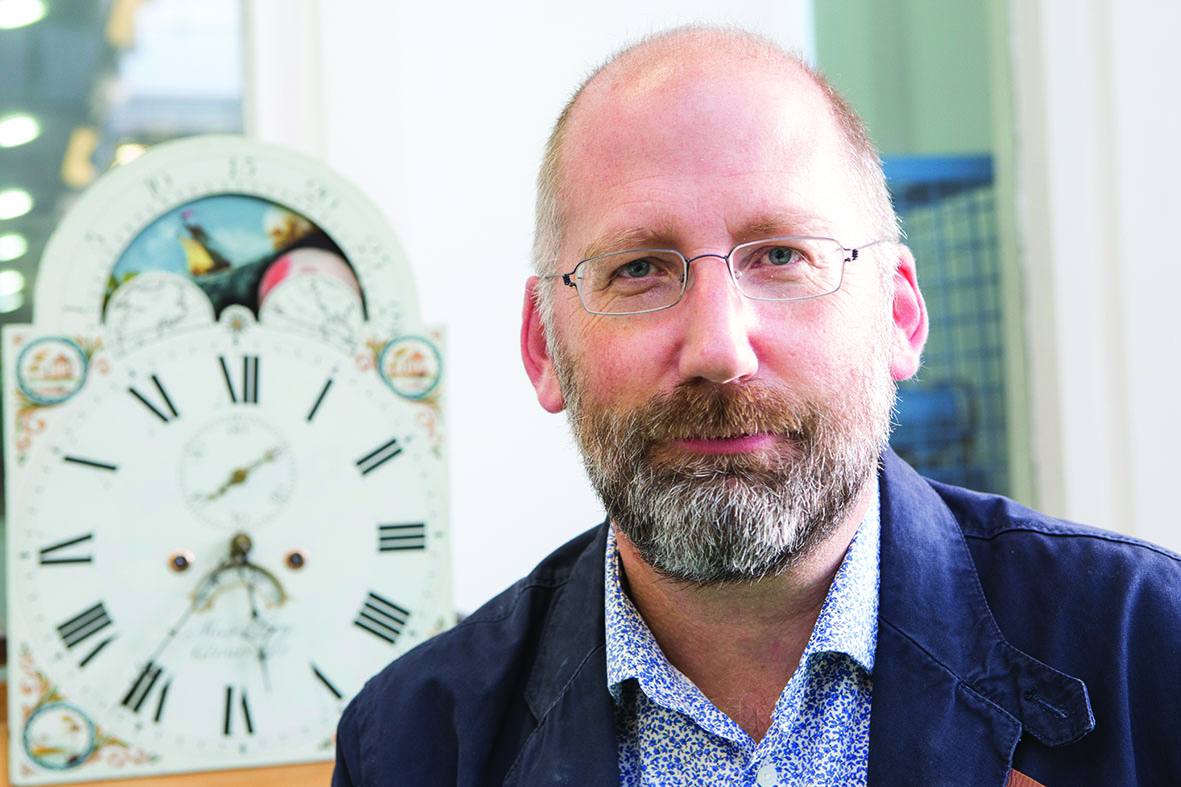
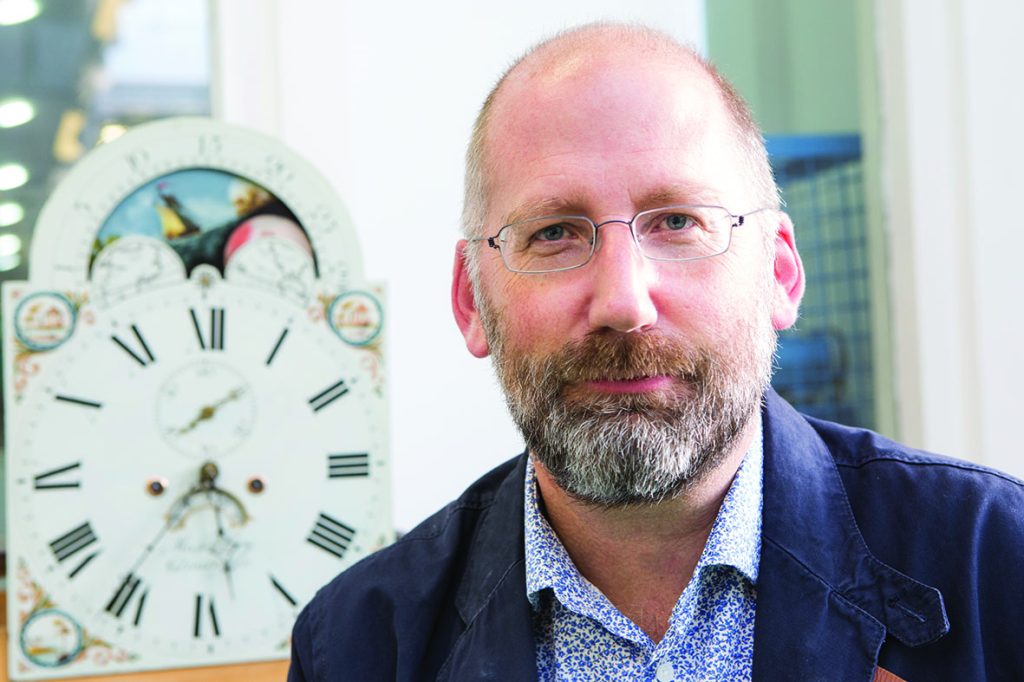
Jeremy Hobbins, who has been synonomous with Birmingham City University’s horology department since 2009 left his post as Deputy Head of the College for Jewellery Fashion and Textiles, at the end of the Summer term and is moving on to pastures new.
Over the years he says there have been many highlights as he has guided hundreds of young horologists into the trade, but describes his favourite times as the ‘lightbulb moment’ when students ‘get what you are teaching them and you see the growth in their capability and confidence as they go on to successful careers’.
Jeremy was born in Portsmouth and says he did not enjoy academia so distracted himself by joining the school shooting team and gaining several prizes. He thinks this is perhaps where he picked up the importance of precision, which served him well in later years. He ‘found horology’ in his early thirties after first pursuing a business studies degree and later moving into catering management.
‘I’ve always been very practically minded and I guess I have my Dad to thank for that,’ he explains. ‘He would involve me in lots of DIY projects as I was growing up and I did a bit of my own car and motorcycle maintenance as a student to save money. I’ve always enjoyed fixing things, getting things to work and problem solving.’
Jeremy says he happened upon the course at the Birmingham School of Jewellery quite by chance as it sounded like something he would find interesting and, by his own admission, he turned out to be quite good at it!
‘I knew nothing about horology, metalworking or even machine work, but learnt a huge amount from my tutors Paul Thurlby and Jim Kynes, as well as from my fellow students – we learn so much from just talking with other like-minded people.
‘After graduating I was fortunate enough to get to know Chris Lowe at Richards of Burton who offered me a safe haven for a year or two, allowing me to embark on a career in clock and watch repair. I worked on a whole range of things and even made new gears and pinions for a church clock as well as tending to domestic clocks.’
Jeremy says he did explore moving down to Fowey in Cornwall to work for Galbraith’s at one point, but decided that it was just too far away from his friends and family in the West Midlands. However he got to know the works manager, Philip Gale, really well and remained in touch right up until his death.
‘I worked for several clock makers over the years and picked up some incredibly useful knowledge, even delving into musical box restoration for a while,’ he added. ‘As I’ve always enjoyed sharing my knowledge, I was attracted to return to the School of Jewellery when a suitable position turned up and my family life meant I could consider it.’
Jeremy joined BCU in Easter 2009 mainly to teach on the BHI course that was running alongside the University’s own HND Horology, working side by side with his old tutor, Jim Kynes. When Jim announced he would taking early retirement, Jeremy took over the leadership of both courses and was asked to merge the two into the degree programme that the Univseristy now run.
‘I’m delighted to say I was helped by Jon Parker through this process and together we created the successful course that runs today with the help of Mat Porton and Jaq Prendergast,’ he said.
Jeremy says he has seen the education programmes at BCU change greatly during his time there:
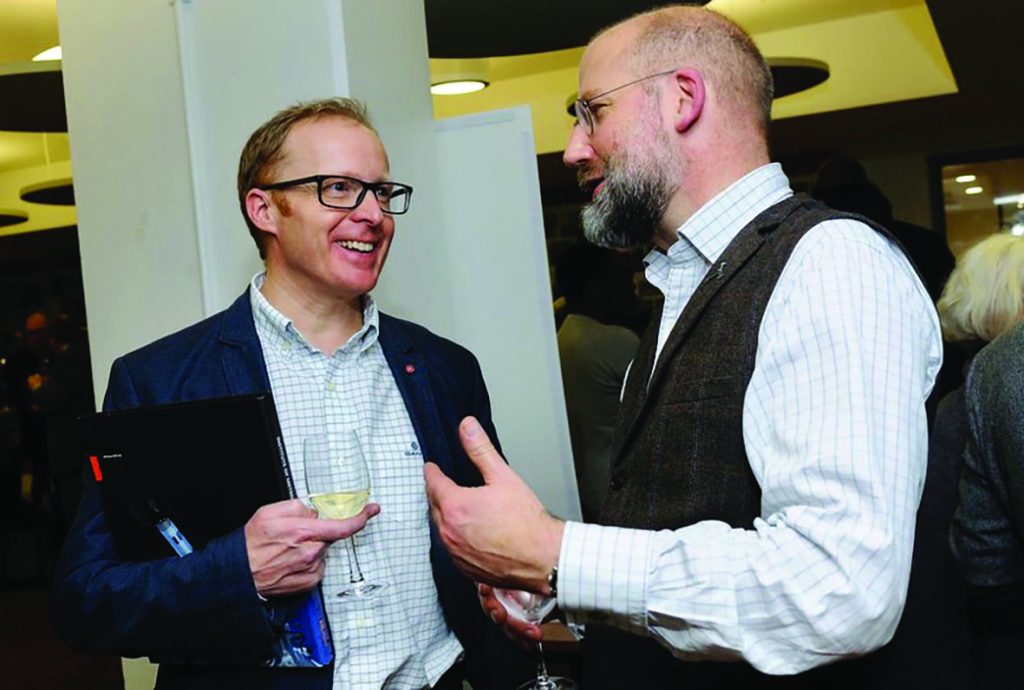
‘The School of Jewellery has allegedly taught horology for over a 100 years. When I was a student there in the early 90s we just had the syllabus of the BHI Distance Learning Course as the basis for the full time programme I undertook. In my final year the University did launch an HND in the subject and so I left with both an HND and a GradBHI qualifications. When I returned as a tutor, the two courses running side by side were very confusing for applicants but also restricted student funding and so we decided to create the three-year degree programme that has run since 2012.’
He adds: ‘The thing about a degree education is that it encompasses a wide range of skills, not just those associated to the specialist disciplines of clock and watchmaking, but also transferrable ones of communication, planning, research and business, and it is across all of these areas that students are assessed and gain their final degree classification.
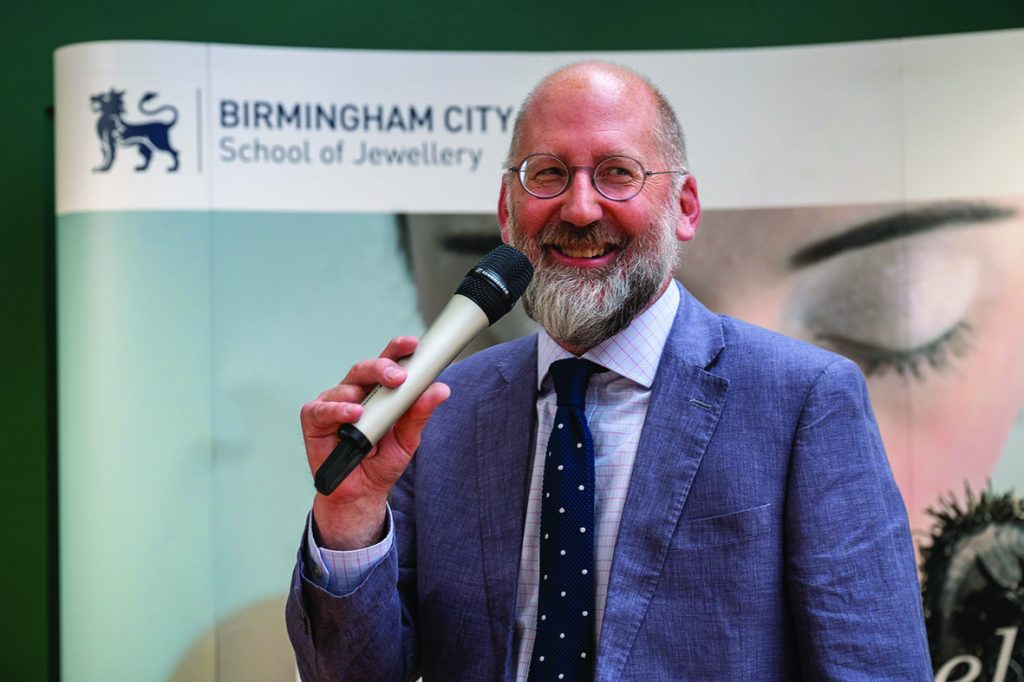
‘The course is not solely training people to be good watch and clock makers, it opens up a wealth of career opportunities and we see people with a creative arts education forging successful careers in many different areas. So while most of the industry judges us on the watch and clock making skills our education provides, they forget how we also create the potential managers and entrepreneurs of the future. I’d love every graduate to get back in touch and tell me where they are and what they are doing!’
Jeremy says that he is afraid for the future of of horological education and feels there are fewer opportunities for young people entering the trade:
‘Sadly in my time connected with horology we have seen the closure of several other educational establishments offering horological training but we have seen the emergence of the British School of Watchmaking to replace the Manchester course of old.
‘The difficulty faced by any young person wanting to become a clock or watchmaker now is how are they going to fund their training, and whilst some employers will take on people from scratch this is typically only the larger organisations. The industry has a wealth of small independent businesses that can often ill afford to fund full training programmes for their employees.
‘Luckily, higher education does at least offer a route that can attract student funding for those choosing this pathway into the industry,’ he adds. ‘However, I’m afraid for the future of horological education. Without greater industry involvement and perhaps the establishing of independent training schools, and in the current climate where many Universities are questioning the running of niche courses it is short sighted to imagine that the course at Birmingham will always exist.
In many ways the future of British horology is promising with organisations like the Guild, the BHI, and the British Watch and Clock Makers Alliance all supporting an increasing range of smaller brands and businesses. There is a greater need than ever for skilled individuals to work in the trade, but the trade needs to consider where these people are going to get their skills from.’
Jeremy says that one of the joys over the years has been to see horology evolving.
‘Anyone who studies the history of horology will see the many changes that have taken place over the years, each adopting the latest technology. As we now move into the world of digital design and manufacture these techniques can be readily applied to our subject area. Computer aided design and additive manufacturing, otherwise known as 3D printing, are widely used but there is still an important place for the hand skills of the traditional horologist.
‘Artificial intelligence will inevitably impact our manufacturing and design but in what way it is too early to tell, however it is already at work in the marketing and promotion aspects of the industry.’
He is also very proud to see successful graduates go on to amazing careers – whether it’s in the British Museum, or the Royal Palaces looking after their collections, or working for the likes of Patek Philippe, Rolex, Swatch, Christopher Ward and many of the other larger servicing centres run by famous brands. He says some students also launch into self-employment or gain valuable experience by working for other specialist smaller organisations in both the clock and specialist watch restoration fields.
During his time at BCU, Jeremy says he has learnt a lot about himself and others and, although there have been challenges along the way, frustrations and lots of change, there has also been fun, success, teamwork, camaraderie and excitement.
The highlights, he says, are many… ‘From VIP visits, by politicians, TV personalities, Hollywood movie stars, members of the Royal Family, to going places to receive accolades such as the Queen’s Anniversary Award at Buckingham Palace, the Goldsmiths Craft & Design College Trophy, not forgetting his own place in the Watchpro Hot 100 – twice!’
He adds: ‘Seeing behind closed doors in the clock workshops at Buckingham Palace and the Houses of Parliament has been great, along with visiting specialist collections and so many fantastic businesses that have welcomed me into their workshops, from one-man-bands to global powerhouses.
Jeremy now plans to relax for a while and have a chance to reflect and focus on what next. ‘I look forward to interesting conversations, and to roaring off into the sunset on my motorcycle,’ he said.